

The Trumpet Player in a Tux at Grand Central
Plus! Storm-panic grocery shopping!! Mystery AI merchandise!!!


Hello everyone,
Welcome to Issue #194 of CAFÉ ANNE!
One of the fun things about a NYC snowstorm is the supermarket panic shopping that goes down, followed by everyone posting photos of the block-long line and empty shelves at the Union Square Trader Joe’s.
Last night, at the tail end of the storm, I went to the Key Food around the corner from my home in Brooklyn Heights to document the scene. I was curious to see what had sold out.
First I spoke with Raymond, the friendly cashier with a great smile at register one. “A lot of the meat is sold out,” he reported. “All the chicken. People went for the ice cream and snacks. And soup! And the toilet paper, that went fast.”
This made sense, but my own observations—on a more granular level— uncovered a more curious trend. See if you can spot the pattern:

Haha! My neighbors were clearly panic-buying the most expensive, high-status versions of everything in the store. Perhaps they were aiming to spend all their money before dying in the storm? Or maybe they envisioned slipping on the ice and then impressing the ambulance workers with their fresh sage and oregano.
This is probably particular to my hood, of course. I wonder what I’d have observed at, say, the Sheepshead Bay Stop & Shop?
In other news, huge snowstorm-shopping shoutouts to our newest paid subscribers Maria V., Marj K. and Ethan N. That’s enough $$$ to buy out the rest of the Key Food bone broth display!
I am very excited for this week’s issue, of course. We’ve got an amazing AI mystery product found in a Park Slope dollar store and a profile of Eganam Segbefia, the elegant trumpet player many of you have enjoyed while passing through Grand Central. Please enjoy.
Regards!
Anne

PRODUCT OF THE MONTH
“Classic of Mountains and Rivers”
Over the weekend, my “friend” Aharon sent me a photo of an intriguing item he’d spotted at Gorilla 99 Cent Plus, a discount store on Fifth Avenue in Park Slope. “Classic of Mountains and Rivers” was available for $2.49.
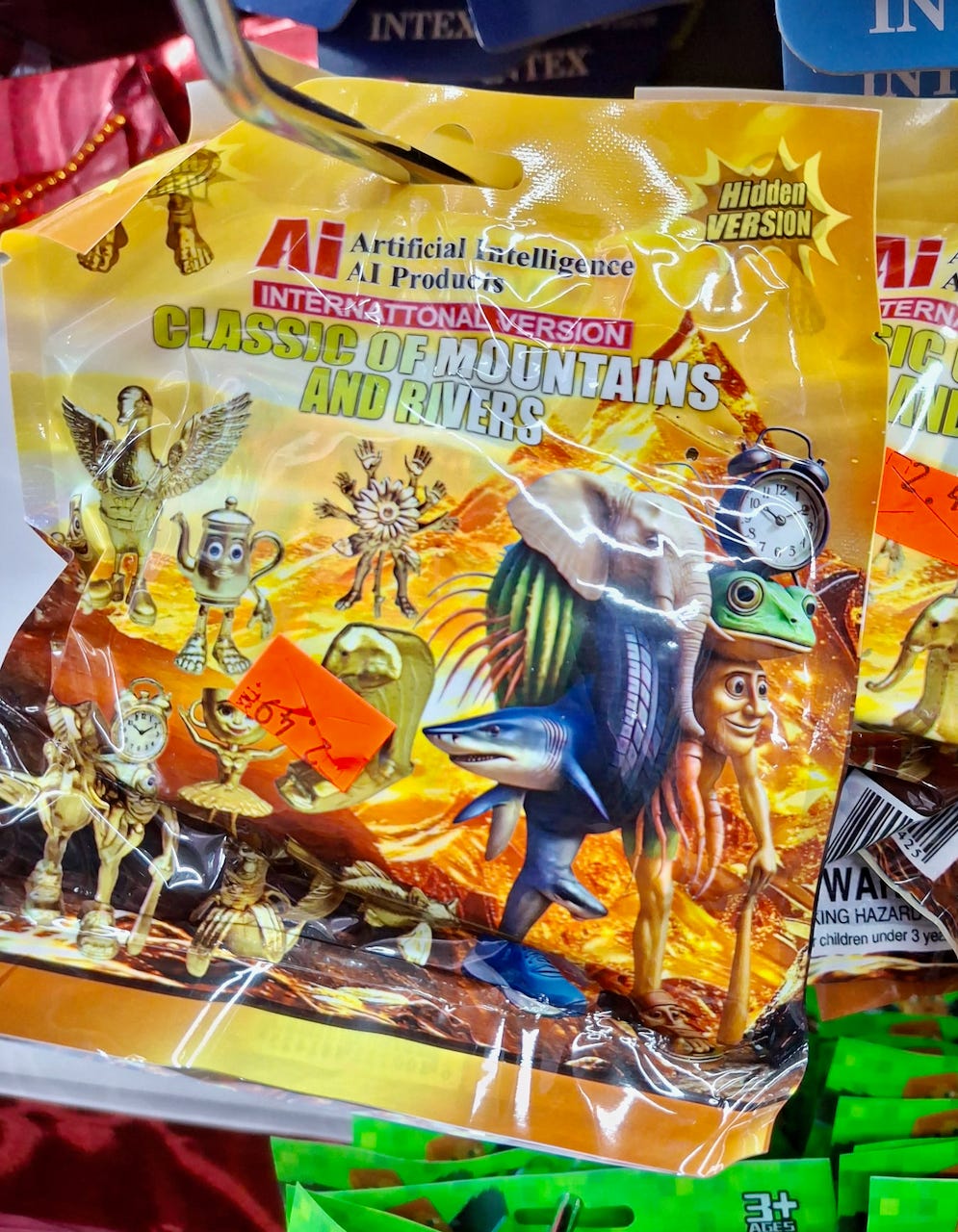
Zooming in for a closer look revealed the name of the manufacturer: “Ai Artificial Intelligence A.I. Products.” I also learned that the item is the “INTERNATIONAL VERSION” and also, according to the text in the upper-right corner, the “Hidden VERSION”.

The illustrations, meanwhile, depicted a number of highly evocative situations including:
-A golden goose with wings outstretched, sporting platform ankle boots
-A terrifying teapot with two eyes, one arm and giant feet
-A frog with an alarm clock on its head
-A great white shark emerging from a truck tire

Were these the actual contents of the bag? Or merely a case of wishful illustration, like the berries adorning the corn flakes in the cereal box photo?
Of course I asked Aharon to go back to the store and buy whatever this thing was. But when he returned to Gorilla 99 Cent Plus on Sunday (in the middle of the crazy snowstorm), the shop was closed. We will all have to wait for the next issue to find out what’s inside.
Meanwhile, I have my guesses, and so does Aharon. “I like to think it contains SLOP,” he texted.
What’s your prediction? Respond in the comments, please, or zap me an email: annekadet@yahoo.com.

PROFILE
The Trumpet Player in a Tux at Grand Central
The first thing I noticed was the music. I was hustling through Grand Central on my way home from the dentist when I heard a trumpet blowing a haunting rendition of Schubert’s “Ave Maria.” It transformed the bustling rush hour scene into something that felt almost holy.
The next thing I noticed was the tux. Turning the corner, I spotted an elegant young man in full-on formal—bow tie and tailcoat—blowing a copper-plated horn. (Check out this video!)
But what stopped me was the vibe. The performer interrupted his playing to dispense birthday greetings to a gawking youngster in a paper crown, then hugged another commuter who approached with open arms. As the crowd grew, he shifted from Randy Newman’s “You’ve Got a Friend in Me” to Shostakovich’s “Waltz No. 2.”
Everyone gathered around—executives, construction guys, tourists—was smiling. And then an older man sidled up to me and murmured, “I think he debuted at Carnegie Hall last week. I saw it on the news.”
I knew I had to interview this trumpet player! I struck up a conversation after he finished his next tune, and we exchanged cards. His read:
Eganam Segbefia
Private Events and Trumpet Lessons
“Inspiration without perspiration is hallucination.”

When we met last week at a café near Grand Central, Mr. Segbefia showed up already dressed in his tux, sans bowtie, so I asked about that.
When he started playing for tips in ten years ago, he wore a black t-shirt and pants. “I tried to be as regular as possible, unassuming,” he said. “I felt self-conscious—like being dressed up added extra pressure.”
Then one day he was watching a cellist in Grand Central: “There was a lady listening and I asked her, ‘Why are you so entranced?’ She said, ‘I love the fact that he wore a tuxedo.’ And I was like, ‘Huh, let me see.’”
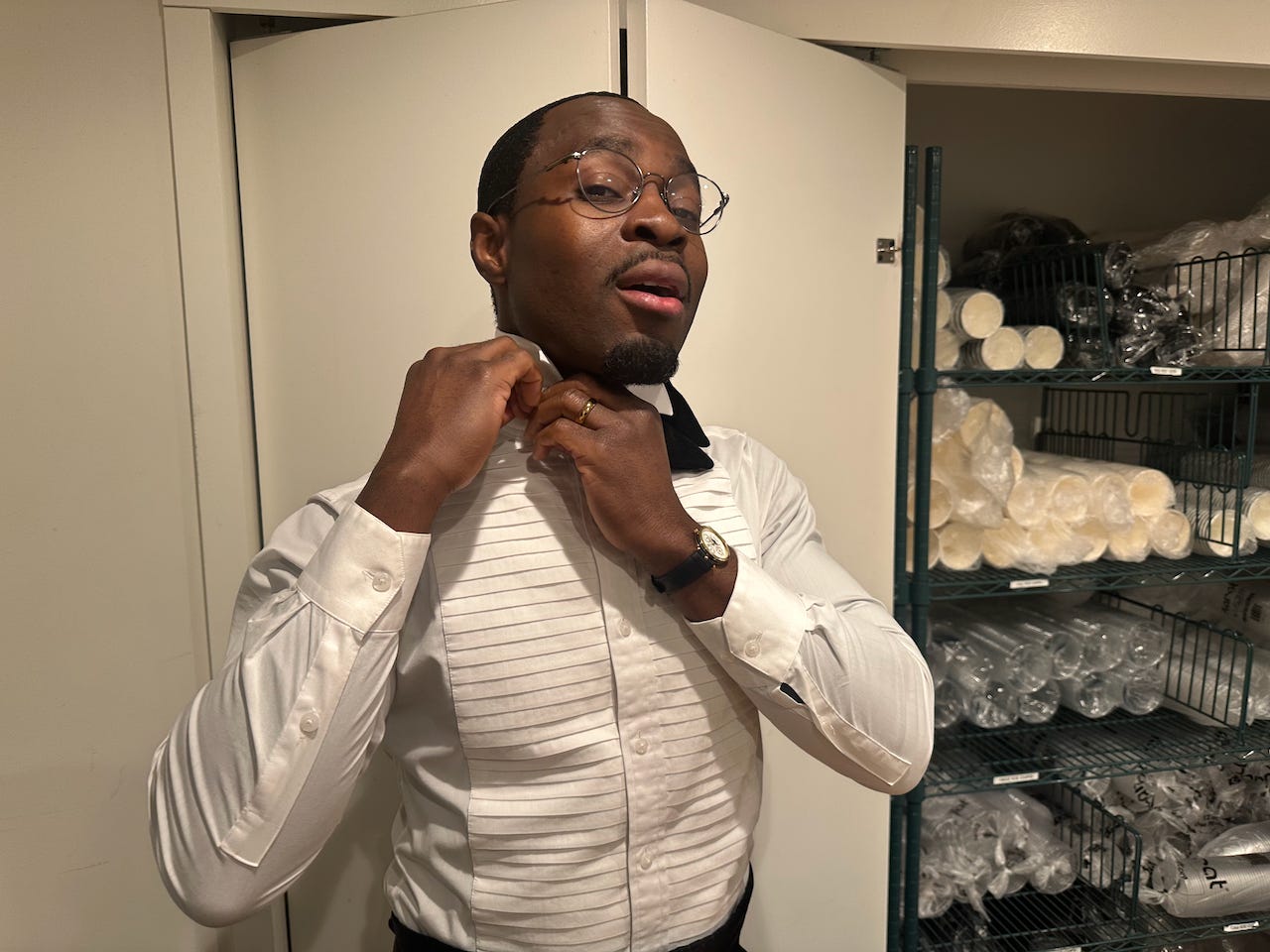
He bought a $90 tux on Amazon and his tips nearly doubled. Now he dresses up for every performance. But it’s not just about the money, he says. Wearing a uniform reminds him that—like a cop or a nurse—he’s on duty, performing a service.
“The job is to make people happy,” he said. “Whether I get paid for it or not, that is secondary. If I was to go back home with an empty bag, I cannot be upset at all, because no one owes me anything.”
It’s not often you hear someone saying no one owes them anything. I was smitten—and that was even before hearing his story. But of course, I am a former business reporter who loves money almost as much as I love music, so I pressed him on the economics of performing at Grand Central.
He plays three four-hour sessions a week. While he asked me not to disclose how much he earns, it’s more than I expected! But a lot goes into the act. He practices four hours a day in the Bronx apartment he shares with his wife, a preschool teacher. And his playlist of 200 tunes is carefully constructed to maximize revenue. He’ll warm up with classical and move into pop songs when rush hour hits. People prefer familiar tunes, he said, so he’ll play “What a Wonderful World” and “Flight of the Bumblebee” several times in one session.
People have tipped with everything from jewelry and cookies to, in one case, a live crab. “He was like, ‘Do you want it?’ I was like, ‘No,’” said Mr. Segbefia. “So he gave me a Bible instead.”
He once got an anonymous note: “For the last two weeks, I’ve been contemplating ending my life and your rendition of ‘What a Wonderful World’ saved me. Thank you.”
While he’s been accepting Venmo, CashApp and Zelle for years, digital payments account for just 5-10% of his tips. Most folks still carry cash, he said, “And people still tip with coins!”
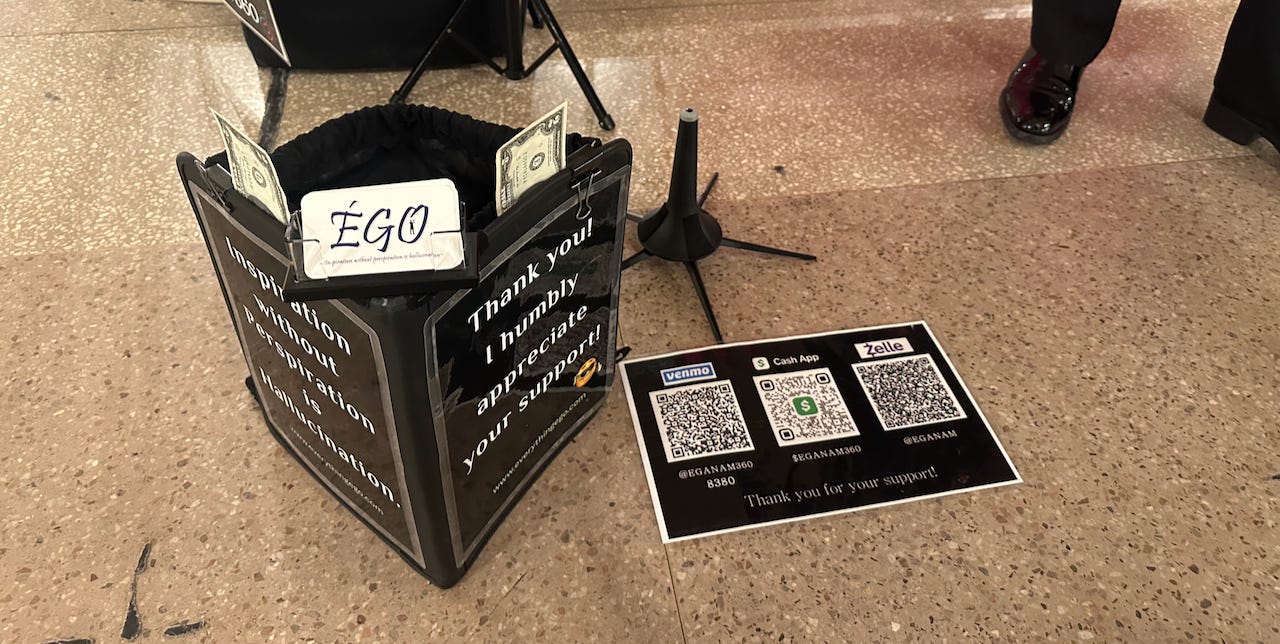
Just before Christmas, Mr. Segbefia went to a Coinstar machine and cashed in the two jugs of coins he’d collected since summer. Coinstar takes a 17% cut, but if you put the cash on an Apple gift card, you keep the entire amount. Mr. Segbefia had enough to buy his wife an iPhone 17.
The gig also brings outside opportunities—commuters hire him to play private events from funerals to cocktail parties. Not to mention performances at St. John the Divine, Lincoln Center and Gracie Mansion.
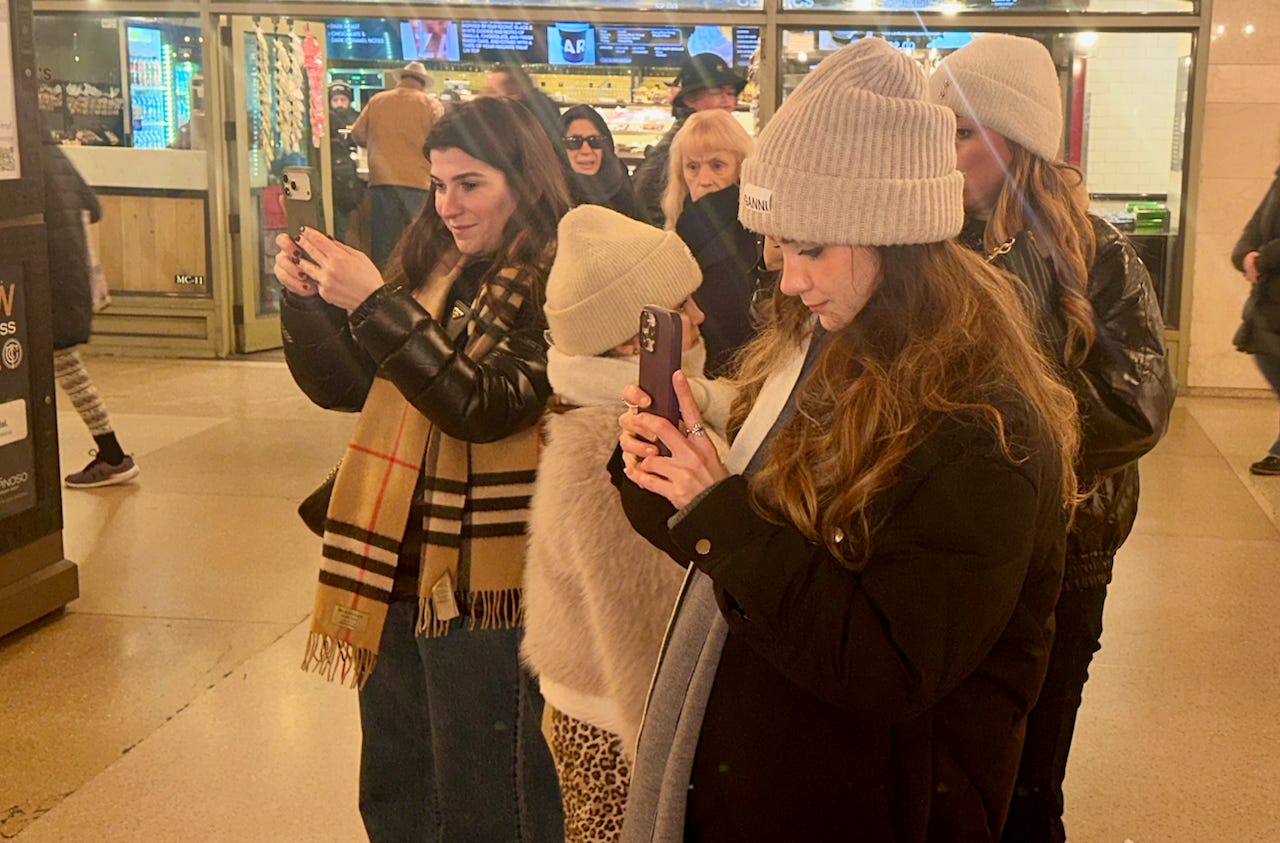
Most people don’t tip at all, of course. They gawk, shoot a video and move on. Mr. Segbefia doesn’t mind. “The dollar, that’s like icing on the cake—it just adds a little bit of sugar to it,” he said. “If I’m out there, I’m out there to touch people, right? That’s it.”

You’d never guess upon meeting him that Mr. Segbefia is from Nigeria. His dad was an electrical engineer who ran a large business. “Lagos was beautiful,” he said of his hometown. “We went to the zoo, we went to museums. I grew up very sheltered.”
But in 1999, when he was ten years old, his folks won a visa lottery and moved to New York City. Mr. Segbefia, his parents and his eight siblings crammed into a two-bedroom apartment in the Bronx. His father got a job as a Toys R Us security guard. It was the middle of February and an unusually snowy winter.
“I was shocked,” he recalled. “What is this place? Why am I wearing so many clothes? Why does this stew—which I now understand is ketchup—have so much sugar in it? I remember the first time I had a hot dog and I was just like, ‘Is this supposed to be food?’”
Starting school mid-year at PS 114 was equally strange. While his classmates looked like him, they talked differently, moved differently, dressed differently. Coming from Africa, he said, “I became the butt of the jokes.”
He took up trumpet in junior high—brass bands are common at Nigerian celebrations—before attending the newly-launched Celia Cruz Bronx High School of Music. Many NYC jazz legends stopped by to play or even perform with the students. “It gave you a chance to see what you could be,” he said.
He next went to South Carolina State University on a scholarship to major in music performance and education. Living in the south was a game-changer, he said. Suddenly he wasn’t the weird kid from Africa, he was the cool guy from New York City.
“I discovered girls, I discovered drinking, so I partied,” he said. “This was 2008 and New York City had just started getting on with the Louis Vuitton, the Gucci and the Prada. I couldn’t afford the actual thing, so I went down to Canal Street and bought it. And in the south, no one can tell. All they see is the brand. So, ‘Wow, oh my God, look at what he’s got.’ And in the south, people see each other all the time. So my friends were like, ‘Oh, you see Jay-Z?’ ‘Yeah, I see Jay-Z all the time.’”
He took seven years to graduate. “In spring, 2015 I told myself, ‘No partying, no girls, no alcohol, no weed, none of that stuff.’ And so I was able to get it done,” he said. “I was really happy and proud of myself. And that also helped me realize that if I really set my mind to something, I can get it done.”
He planned to teach music in city schools but life had other ideas. Unable to land a teaching job or steady work as a performer, he found himself with a minimum wage gig drying wine glasses at Jean-Georges. That’s when he turned to busking.
He remembers his first performance—outside Yankee Stadium before a game. He played for just under an hour and earned $8. But a friend encouraged him to try again after the game. This time he earned $45.
He played in parks, he played on subway platforms, and when the weather got cold, he played Grand Central. You can’t perform in the famous terminal without a permit, of course, but his appearances caught the attention of Sandra Bloodworth, the MTA’s Director of Art and Design who encouraged him to audition for the agency’s Music Under New York program which designates locations throughout the transit system for live performances. At his first audition, Mr. Segbefia won a coveted slot at Grand Central.
His unusual trajectory won him a scholarship to the prestigious Manhattan School of Music where he earned his master’s in classical trumpet. And after winning the first New York Knicks “That’s NY Talent” halftime competition, he’s been a regular playing the national anthem before games at Madison Square Garden.
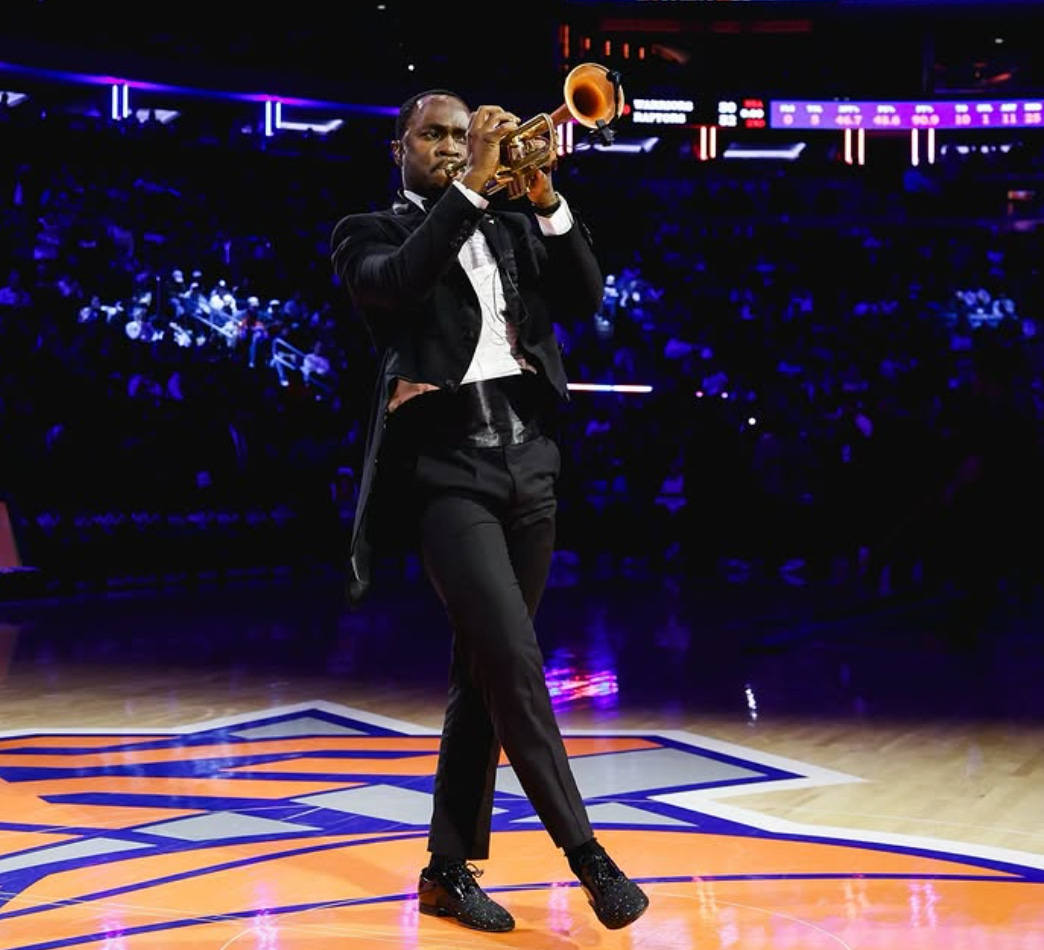
“It’s the world’s most famous arena. And playing there, there’s pride, privilege and honor,” he said. “When you play the national anthem, you have to realize people have died for that song.”
But Grand Central is hard to beat. “I believe every musician, regardless of what you play, should busk at some point in their life,” he said. “Because, being a musician, you have to serve society. And here, everybody comes by. It could be billionaires, it could be a transit worker, Republican, Democrat, doesn’t matter. You don’t get to choose who hears. There’s times where I’ll be playing and a homeless person will come and drop a dollar. Who am I to say, ‘Yo, I don’t need your dollar. You need it more than me.’ Because I’m standing out there, you know. It helps me to be humble.”
“I think it’s the greatest place in New York City,” I said of the station.
“I agree with you because there are times, when I’m playing, it sounds like I’m in a cathedral,” he said.
It was time for Mr. Segbefia to start his Tuesday afternoon shift. We walked a block to Grand Central and he set up in front of Zaro’s bakery, unpacking his iPad and coconut water, slipping hot packs into his pockets. It gets cold in the station, and he warms his hands between tunes to keep his fingers nimble.
Before he could start playing, he was interrupted by a fan, Brooklyn lawyer and novelist David Secular. “I stop whenever he plays!” said Mr. Secular. “I wanted to hire him for my son’s wedding. My son had other ideas.”
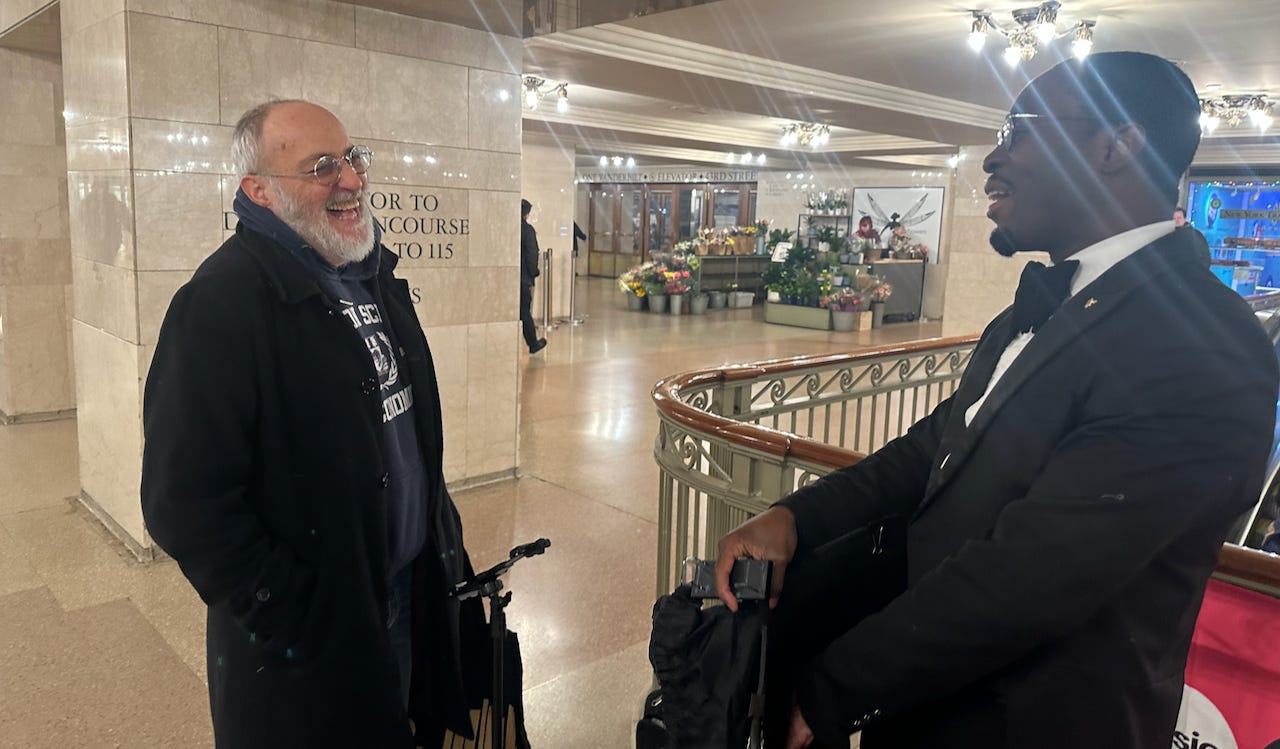
Mr. Secular told me he’d just gone to see Mr. Segbefia perform at Carnegie Hall with former Yankees center fielder and musician Bernie Williams. “It was sold out,” he said.
I’d totally forgotten the Carnegie Hall performance. I turned to Mr. Segbefia. “Eganam, you played at Carnegie Hall last week. I can’t believe you didn’t tell me. You’re so weird!”
“Well,” he said, “I figured she’ll find out when she finds out.”
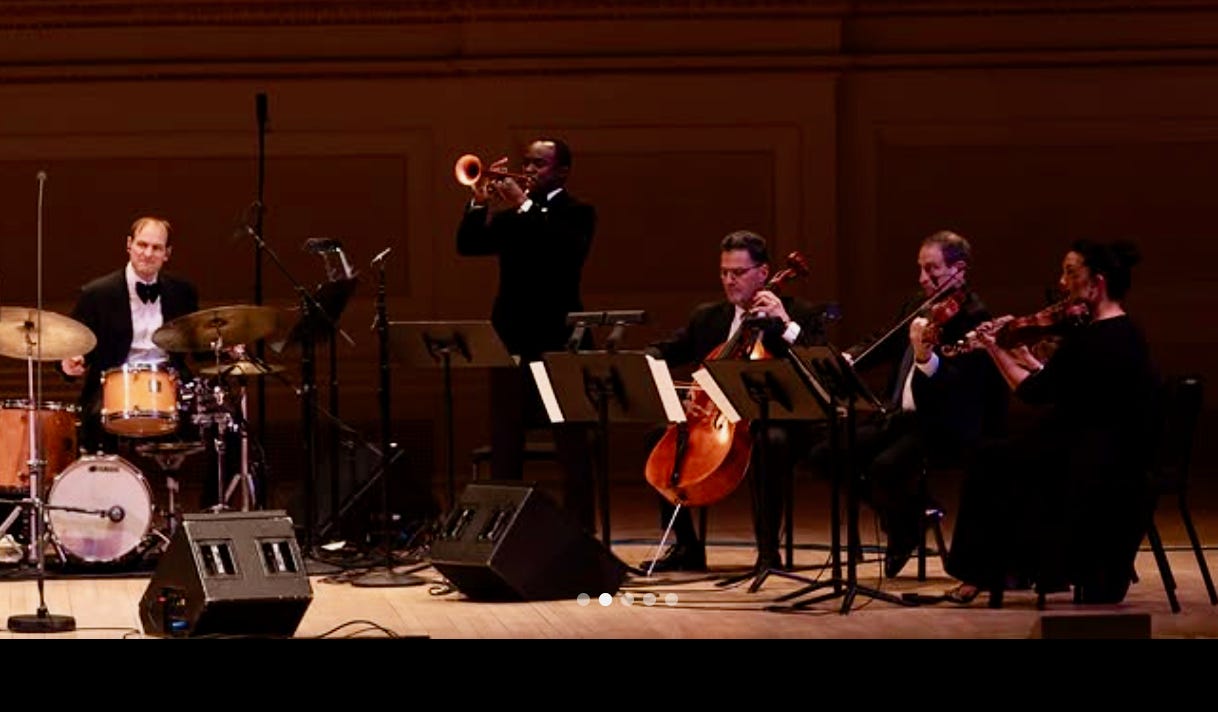
Mr. Segbefia said he lands enough private gigs these days that he no longer needs to play Grand Central. But he keeps returning to keep his chops up. If you can hold a crowd in the city’s most bustling station, you can hold your own anywhere.
So what’s next? I was surprised when the trumpet player said the end game isn’t stardom. He plans on returning to his homeland to start a music school.
“100 years from now,” he said, “If someone reads about me, I want them to read that my dad made a sacrifice, I came to this country, got the education that I needed and then went back home and invested into my people.”
“I don’t want to be remembered for all the glamour things,” he continued. “It’s how many people did I make smile today? How many people did I share music with? How many people did I help put through school—so that they can get an education and move further than what I’ve done?”

QUOTE OF OF THE WEEK
“Big storm on the way. Reminder: I don’t run City Hall anymore. Yelling at me on Twitter will not speed up snow removal.”
—Eric Adams

CAFÉ ANNE, a free weekly newsletter about NYC, is created by Brooklyn journalist Anne Kadet. Subscribe to get the latest issue every Monday.
Just completely wowed by such an amazing being! Thank you Cafe Anne!
Thank you Anne! This story about the trumpet player lifted my spirits which have been shattered by recent events in the news. What a wonderful young man whose immigration story has such a beautiful expressed purpose. May he be safe& protected in this turbulent atmosphere.